We remain fully operational. Our teams are working around the clock to ensure your deliveries continue safely.

قم بتنزيل التطبيق


معلومات عنا
حقوق الطبع والنشر © 2024 Desertcart Holdings Limited
قم بتنزيل التطبيق


Buy anything from 5,000+ international stores. One checkout price. No surprise fees. Join 2M+ shoppers on Desertcart.
Desertcart purchases this item on your behalf and handles shipping, customs, and support to QATAR.
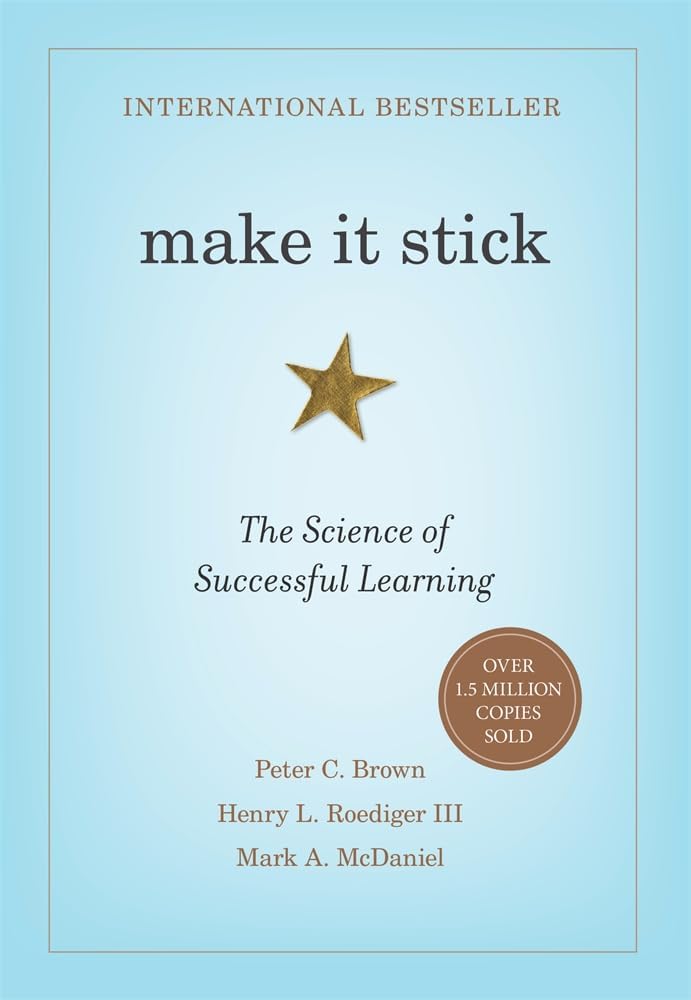
Make It Stick: The Science of Successful Learning [Brown, Peter C., Roediger III, Henry L., McDaniel, Mark A.] on desertcart.com. *FREE* shipping on qualifying offers. Make It Stick: The Science of Successful Learning Review: Finally a learning book based on science! - Summary of the key concepts in the book: Conventional Wisdom: Make learning easy Best practice: Design learning with desirable difficulties Discussion: “Learning is deeper and more durable when it is effortful.” “Difficulties that elicit more effort and that slow down learning… will more than compensate for their inconvenience by making the learning stronger, more precise, and more enduring. Short-term impediments that make for stronger learning have come to be called desirable difficulties.” “Don’t assume you are doing something wrong if the learning feels hard.” “Not all difficulties in learning are desirable ones. Anxiety while taking a test seems to represent an undesirable difficulty.” Slow down to find meaning. Always read prior to the lecture. “Training has to be engaging in order to hold employees’ attention.” Conventional Wisdom: Concentrate on one topic at a time (aka. massed practice) Best practice: Interleave different but related topics Discussion: “Learning from interleaved practice feels slower than learning from massed practice.” While interleaving can impede performance during initial learning (tests taken immediately after exposure), interleaving has been show to boost “final test performance by a remarkable 215 percent.” In addition, “commonalities… learned through massed practice proved less useful than the differences … learned through interleaving.” “In interleaving, you don’t move from a complete practice set of one topic to go to another. You switch before each practice is complete… You need to shuffle your flashcards.” Conventional Wisdom: Reread material multiple times and in close succession Best practice: Space repetition Discussion: “Repetition by itself does not lead to good long-term memory… It makes sense to reread a text once if there’s been a meaningful lapse [at least a day in between] since the first reading.” “The increased effort required to retrieve the learning after a little forgetting has the effect of retriggering consolidation, further strengthening memory.” “Design quizzing and exercises to reach back to concepts and learning covered earlier in the term, so that retrieval practices continues and the learning is cumulative.” Spiral upward at increasing levels of difficulty with each re-exposure. Conventional Wisdom: Reread to lock-in knowledge Best practice: Focus on effortful recall of facts or concepts or events from memory (aka. Retrieval practice) Discussion: “Retrieving knowledge and skill from memory should become your primary study strategy in place of rereading.” There are many methods of retrieval practice. Elaboration, expressing new material in your own words and connecting it with what you already know to find new layers of meaning, for instance by writing daily summaries, is the most effective. Moreover, “cultivating the habit of reflecting on ones’ experiences, of making them into a story, strengthens learning.” Essays and short answer tests are the next most effective durable learning strategies because they involve “Generation… an attempt to answer a question… before being shown the answer”, followed by practice with flash cards, reflection, and, least effective though still useful, multiple choice or true/false questions. To foster this, convert main points into questions to answer during subsequent studying rather than (or in addition to) highlighting and underling, Conventional Wisdom: Conduct pop-quizzes and high-stakes post-testing with a goal toward errorless results Best practice: Conduct frequent, predictable, low-stakes testing (including pre-testing) Discussion: “Trying to solve a problem before being taught the solution leads to better learning, even when errors are made in the attempt.” In fact, “making mistakes and correcting them builds the bridges to advanced learning.” In addition, frequent quizzing – especially when quizzes are announced in advance - actually reduces learner anxiety. With respect to anxiety, the peak-end rule applies; people judge experiences based on how they were at the peak and at the end. Appreciate that “errors are a natural part of learning.” “Make quizzing and practice exercises count toward the course grade, even if for very low stakes.” Set “clear learning objectives prior to each class.” Conventional Wisdom: Match instructional style to each learner’s preference Best practice: Match instructional style to the nature of the content Discussion: While people do have preferred learning styles (ex: visual, auditory, kinesthetic, tactile), empirical research does not support the notion that learning in your preferred style leads to superior outcomes. “When instructional style matches the nature of the content, all learners learn better, regardless of their differing preferences for how the material is taught.” Conventional Wisdom: Memorize Best practice: Extract underlying principles (aka “rule learning” and “structure building”) Discussion: “It is better to solve a problem than to memorize a solution.” “Mnemonic devise are sometimes discounted as tricks of memory, not tools that fundamentally add to learning, and in a sense this is correct. The value of mnemonics to raise intellectual abilities comes after mastery of new material.” Conventional Wisdom: Learn abstract concepts Best practice: Learn using methods and examples that are concrete and personal Discussion: “The kind of retrieval practice that proves most effective is one that reflects what you’ll be doing with the knowledge later. It’s not just what you know, but how you practice what you know that determines how well the learning serves you later.” Simulations and role-playing are excellent techniques. “Difficulties that don’t strengthen the skills you will need, or the kinds of challenges you are likely to encounter in the real-world application of your learning, are not desirable.” “Practice like you play, because you will play like you practice.” “Sustained deliberate practice… [is] goal-directed, often solitary, and consists of repeated striving to reach beyond your current level of performance.” Conventional Wisdom: Read without pausing Best practice: Spend 40% of time reading and 60% of time “looking up from the material and silently reciting” what it contains. Conventional Wisdom: Provide immediate feedback Best practice: Delay feedback Discussion: “Delaying the feedback briefly produces better long-term learning than immediate feedback.” That said, receiving immediate corrective feedback is better than receiving no feedback at all. Conventional Wisdom: Review all concepts equally Best practice: Disproportionately focus on the least familiar material (aka dynamic testing) Discussion: To increase frequency of practice on less familiar material without completely ignoring the most familiar material, use the Leitner box method. “Think of it as a series of four file-card boxes. In the first are the study materials… that must be practices frequently because you often make mistakes in them. In the second box are the cards you’re pretty good at, and that box gets practiced less often than the first, perhaps by half. The cards in the third box are practiced less often than those in the second box, and so on.” Conventional Wisdom: Accept that IQ is fixed Best practice: Focus on mindset Discussion: “Average IQs have risen over the past century with changes in living conditions... IQ is a product of genes and environment” including increased stimulation, nurturing, nutrition “One difference that matters a lot is how you see yourself and your abilities. As the maxim goes, ‘Whether you think you can or you think you can’t, you’re right.’” Adopt a growth mindset rather than a fixed mindset; “consider your expertise to be in a continuing state of development.” “Success is less dependent on IQ than on grit, curiosity, and persistence.” Knowledge is a foundational element of creativity, critical thinking, and application. “The upper limits of your performance on any cognitive or manual skill may be set by factors beyond your control, such as you intelligence and the natural limits of your ability, but most of us can learn to perform nearer to our full potential in most areas by discovering our weaknesses and working to bring them up.” “Achieving expertise in any field if particular to that field… The central idea here is that expert performance is a product of the quantity of and the quality of practice, not of genetic predisposition, and that becoming expert is not beyond the reach of normally gifted people who have the motivation, time, and discipline to pursue it.” Conventional Wisdom: Trust your own sense of mastery Best practice: Calibrate your judgment Discussion: “Calibration is the act of aligning your judgments of what you know and don’t know with objective feedback so as to avoid being carried off by the illusions of mastery that catch many learning by surprise at test time.” Note: This book practices what it preaches with lots and lots of repetition. The authors are up-front about that but it does get well... repetitive. Review: The book is packed with Big Ideas. - “People generally are going about learning the wrong ways. Empirical research into how we learn and remember shows that much of what we take for gospel about how to learn turns out to be largely wasted effort. Even college and medical students—whose main job is learning—rely on study techniques that are far from optimal. At the same time, this field of research, which goes back 125 years but has been particularly fruitful in recent years, has yielded a body of insights that constitute a growing science of learning: highly effective, evidence-based strategies to replace less effective but widely accepted practices that are rooted in theory, lore, and intuition. But there’s a catch: the most effective learning strategies are not intuitive. ... This is a book about what people can do for themselves right now in order to learn better and remember longer. ... We write for students and teachers, of course, and for all readers for whom effective learning is a high priority: for trainers in business, industry, and the military; for leaders of professional associations offering in-service training to their members; and for coaches. We also write for lifelong learners nearing middle age or older who want to hone their skills so as to stay in the game. While much remains to be known about learning and its neural underpinnings, a large body of research has yielded principles and practical strategies that can be put to work immediately, at no cost, and to great effect.” ~ Peter Brown, Henry Roediger, Mark McDaniel from Make It Stick Want to learn about the science of successful learning? Then this is the book for you. Make It Stick is written by story-teller Peter Brown and two leading cognitive scientists who have spent their careers studying learning and memory: Henry Roediger and Mark McDaniel. It’s a fascinating exploration of what science says about the most effective learning techniques— shining light on the techniques that actually work and those that do not work—even though we may think they do! Hint: Rereading, massed “practice-practice-practice” sessions, and cramming are not wise strategies. Active retrieval, interleaving, spaced repetition, reflection, elaboration, getting your mind right and practicing like an expert, on the other hand, are very good strategies. Here are some of my favorite Big Ideas: 1. Fluency vs. Mastery - Don't just go w/your feelings. 2. Cranberries + Testing - Active retrieval is where it's at. 3. Curveballs - Interleave yourself some curves. 4. Elaboration - Explain it like I'm 5. 5. Testing - Static vs. Dynamic. To optimizing and actualizing and making it stick!


| Best Sellers Rank | #5,456 in Books ( See Top 100 in Books ) #1 in Study & Test-Taking Skills (Books) #2 in Educational Psychology (Books) #7 in Cognitive Psychology (Books) |
| Customer Reviews | 4.6 4.6 out of 5 stars (4,707) |
| Dimensions | 5.5 x 1 x 8.25 inches |
| Edition | Pilot Project. eBook Available to Selected Us Libraries Only ed. |
| ISBN-10 | 0674729013 |
| ISBN-13 | 978-0674729018 |
| Item Weight | 1.1 pounds |
| Language | English |
| Print length | 336 pages |
| Publication date | April 14, 2014 |
| Publisher | Belknap Press: An Imprint of Harvard University Press |
J**N
Finally a learning book based on science!
Summary of the key concepts in the book: Conventional Wisdom: Make learning easy Best practice: Design learning with desirable difficulties Discussion: “Learning is deeper and more durable when it is effortful.” “Difficulties that elicit more effort and that slow down learning… will more than compensate for their inconvenience by making the learning stronger, more precise, and more enduring. Short-term impediments that make for stronger learning have come to be called desirable difficulties.” “Don’t assume you are doing something wrong if the learning feels hard.” “Not all difficulties in learning are desirable ones. Anxiety while taking a test seems to represent an undesirable difficulty.” Slow down to find meaning. Always read prior to the lecture. “Training has to be engaging in order to hold employees’ attention.” Conventional Wisdom: Concentrate on one topic at a time (aka. massed practice) Best practice: Interleave different but related topics Discussion: “Learning from interleaved practice feels slower than learning from massed practice.” While interleaving can impede performance during initial learning (tests taken immediately after exposure), interleaving has been show to boost “final test performance by a remarkable 215 percent.” In addition, “commonalities… learned through massed practice proved less useful than the differences … learned through interleaving.” “In interleaving, you don’t move from a complete practice set of one topic to go to another. You switch before each practice is complete… You need to shuffle your flashcards.” Conventional Wisdom: Reread material multiple times and in close succession Best practice: Space repetition Discussion: “Repetition by itself does not lead to good long-term memory… It makes sense to reread a text once if there’s been a meaningful lapse [at least a day in between] since the first reading.” “The increased effort required to retrieve the learning after a little forgetting has the effect of retriggering consolidation, further strengthening memory.” “Design quizzing and exercises to reach back to concepts and learning covered earlier in the term, so that retrieval practices continues and the learning is cumulative.” Spiral upward at increasing levels of difficulty with each re-exposure. Conventional Wisdom: Reread to lock-in knowledge Best practice: Focus on effortful recall of facts or concepts or events from memory (aka. Retrieval practice) Discussion: “Retrieving knowledge and skill from memory should become your primary study strategy in place of rereading.” There are many methods of retrieval practice. Elaboration, expressing new material in your own words and connecting it with what you already know to find new layers of meaning, for instance by writing daily summaries, is the most effective. Moreover, “cultivating the habit of reflecting on ones’ experiences, of making them into a story, strengthens learning.” Essays and short answer tests are the next most effective durable learning strategies because they involve “Generation… an attempt to answer a question… before being shown the answer”, followed by practice with flash cards, reflection, and, least effective though still useful, multiple choice or true/false questions. To foster this, convert main points into questions to answer during subsequent studying rather than (or in addition to) highlighting and underling, Conventional Wisdom: Conduct pop-quizzes and high-stakes post-testing with a goal toward errorless results Best practice: Conduct frequent, predictable, low-stakes testing (including pre-testing) Discussion: “Trying to solve a problem before being taught the solution leads to better learning, even when errors are made in the attempt.” In fact, “making mistakes and correcting them builds the bridges to advanced learning.” In addition, frequent quizzing – especially when quizzes are announced in advance - actually reduces learner anxiety. With respect to anxiety, the peak-end rule applies; people judge experiences based on how they were at the peak and at the end. Appreciate that “errors are a natural part of learning.” “Make quizzing and practice exercises count toward the course grade, even if for very low stakes.” Set “clear learning objectives prior to each class.” Conventional Wisdom: Match instructional style to each learner’s preference Best practice: Match instructional style to the nature of the content Discussion: While people do have preferred learning styles (ex: visual, auditory, kinesthetic, tactile), empirical research does not support the notion that learning in your preferred style leads to superior outcomes. “When instructional style matches the nature of the content, all learners learn better, regardless of their differing preferences for how the material is taught.” Conventional Wisdom: Memorize Best practice: Extract underlying principles (aka “rule learning” and “structure building”) Discussion: “It is better to solve a problem than to memorize a solution.” “Mnemonic devise are sometimes discounted as tricks of memory, not tools that fundamentally add to learning, and in a sense this is correct. The value of mnemonics to raise intellectual abilities comes after mastery of new material.” Conventional Wisdom: Learn abstract concepts Best practice: Learn using methods and examples that are concrete and personal Discussion: “The kind of retrieval practice that proves most effective is one that reflects what you’ll be doing with the knowledge later. It’s not just what you know, but how you practice what you know that determines how well the learning serves you later.” Simulations and role-playing are excellent techniques. “Difficulties that don’t strengthen the skills you will need, or the kinds of challenges you are likely to encounter in the real-world application of your learning, are not desirable.” “Practice like you play, because you will play like you practice.” “Sustained deliberate practice… [is] goal-directed, often solitary, and consists of repeated striving to reach beyond your current level of performance.” Conventional Wisdom: Read without pausing Best practice: Spend 40% of time reading and 60% of time “looking up from the material and silently reciting” what it contains. Conventional Wisdom: Provide immediate feedback Best practice: Delay feedback Discussion: “Delaying the feedback briefly produces better long-term learning than immediate feedback.” That said, receiving immediate corrective feedback is better than receiving no feedback at all. Conventional Wisdom: Review all concepts equally Best practice: Disproportionately focus on the least familiar material (aka dynamic testing) Discussion: To increase frequency of practice on less familiar material without completely ignoring the most familiar material, use the Leitner box method. “Think of it as a series of four file-card boxes. In the first are the study materials… that must be practices frequently because you often make mistakes in them. In the second box are the cards you’re pretty good at, and that box gets practiced less often than the first, perhaps by half. The cards in the third box are practiced less often than those in the second box, and so on.” Conventional Wisdom: Accept that IQ is fixed Best practice: Focus on mindset Discussion: “Average IQs have risen over the past century with changes in living conditions... IQ is a product of genes and environment” including increased stimulation, nurturing, nutrition “One difference that matters a lot is how you see yourself and your abilities. As the maxim goes, ‘Whether you think you can or you think you can’t, you’re right.’” Adopt a growth mindset rather than a fixed mindset; “consider your expertise to be in a continuing state of development.” “Success is less dependent on IQ than on grit, curiosity, and persistence.” Knowledge is a foundational element of creativity, critical thinking, and application. “The upper limits of your performance on any cognitive or manual skill may be set by factors beyond your control, such as you intelligence and the natural limits of your ability, but most of us can learn to perform nearer to our full potential in most areas by discovering our weaknesses and working to bring them up.” “Achieving expertise in any field if particular to that field… The central idea here is that expert performance is a product of the quantity of and the quality of practice, not of genetic predisposition, and that becoming expert is not beyond the reach of normally gifted people who have the motivation, time, and discipline to pursue it.” Conventional Wisdom: Trust your own sense of mastery Best practice: Calibrate your judgment Discussion: “Calibration is the act of aligning your judgments of what you know and don’t know with objective feedback so as to avoid being carried off by the illusions of mastery that catch many learning by surprise at test time.” Note: This book practices what it preaches with lots and lots of repetition. The authors are up-front about that but it does get well... repetitive.
B**S
The book is packed with Big Ideas.
“People generally are going about learning the wrong ways. Empirical research into how we learn and remember shows that much of what we take for gospel about how to learn turns out to be largely wasted effort. Even college and medical students—whose main job is learning—rely on study techniques that are far from optimal. At the same time, this field of research, which goes back 125 years but has been particularly fruitful in recent years, has yielded a body of insights that constitute a growing science of learning: highly effective, evidence-based strategies to replace less effective but widely accepted practices that are rooted in theory, lore, and intuition. But there’s a catch: the most effective learning strategies are not intuitive. ... This is a book about what people can do for themselves right now in order to learn better and remember longer. ... We write for students and teachers, of course, and for all readers for whom effective learning is a high priority: for trainers in business, industry, and the military; for leaders of professional associations offering in-service training to their members; and for coaches. We also write for lifelong learners nearing middle age or older who want to hone their skills so as to stay in the game. While much remains to be known about learning and its neural underpinnings, a large body of research has yielded principles and practical strategies that can be put to work immediately, at no cost, and to great effect.” ~ Peter Brown, Henry Roediger, Mark McDaniel from Make It Stick Want to learn about the science of successful learning? Then this is the book for you. Make It Stick is written by story-teller Peter Brown and two leading cognitive scientists who have spent their careers studying learning and memory: Henry Roediger and Mark McDaniel. It’s a fascinating exploration of what science says about the most effective learning techniques— shining light on the techniques that actually work and those that do not work—even though we may think they do! Hint: Rereading, massed “practice-practice-practice” sessions, and cramming are not wise strategies. Active retrieval, interleaving, spaced repetition, reflection, elaboration, getting your mind right and practicing like an expert, on the other hand, are very good strategies. Here are some of my favorite Big Ideas: 1. Fluency vs. Mastery - Don't just go w/your feelings. 2. Cranberries + Testing - Active retrieval is where it's at. 3. Curveballs - Interleave yourself some curves. 4. Elaboration - Explain it like I'm 5. 5. Testing - Static vs. Dynamic. To optimizing and actualizing and making it stick!
W**S
Really helping me rethink my approach to my own learning as well as my teaching to be more effective.
G**I
Libro mastro sui metodi di studio efficaci ed efficienti !! Da avere assolutamente
C**E
Desde que la OCDE viene aplicando sus exámenes PISA ha habido un vacío en técnicas de aprendizaje eficaces y eficientes. Make it stick colabora, con mucho, a llenar ese vacío.
M**N
Very good lecture for you to change the way you study and teaching
O**R
Me lo compré en papel después de haber comprado (y escuchado) la versión en audiolibro en (...) (pertenece a Amazon). Es un libro que me ha gustado tanto que quiero tenerlo en papel, para poder prestarlo a mis amigos. En él descubres que ciertas formas que suponías que eran adecuadas para aprender no son las que dan el mejor rendimiento a largo plazo. Es interesante para todos, pero en especial para padres (para que unos encaminen a sus hijos hacia formas más adecuadas de aprender) y para docentes (para que vean si deben cambiar la forma en que abordan la enseñanza).
ترست بايلوت
منذ 5 أيام
منذ شهر