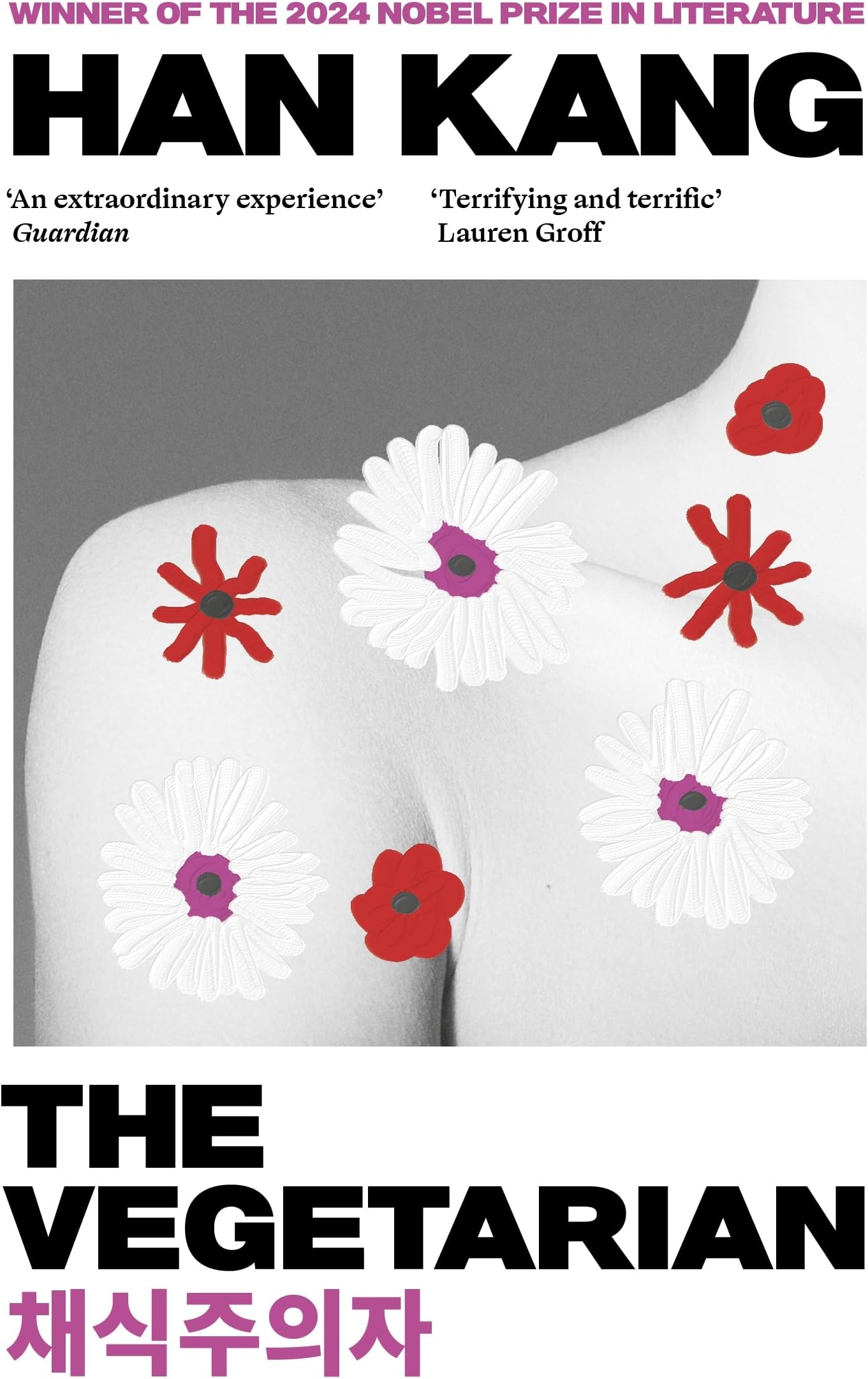
The Vegetarian: Winner of the 2024 Nobel Prize in Literature
Product ID: 49375336
Desertcart purchases this item on your behalf and handles shipping, customs, and support to QATAR.
WINNER OF THE 2024 NOBEL PRIZE IN LITERATURE WINNER OF THE INTERNATIONAL BOOKER PRIZE 'A strange, painfully tender exploration of the brutality of desire indulged and the fatality of desire ignored... Exquisite' Eimear McBride Yeong-hye and her husband are ordinary people - dutiful wife and mild-mannered office worker. One day, prompted by grotesque recurring nightmares, Yeong-hye decides to become a vegetarian. But in South Korea, where vegetarianism is almost unheard-of and societal mores are strictly obeyed, it is a shocking act of subversion. Yeong-hye's passive rebellion rapidly manifests in ever more bizarre and frightening forms, from sexual sadism to attempted suicide, and in increasingly erotic and unhinged artworks, as all the while she spirals further into her fantasies... Disturbing and beautiful by turns, The Vegetarian is a revelatory novel about modern day South Korea; a tale of shame, desire and our faltering attempts to understand others.

| Dimensions | 12.9 x 1.1 x 19.8 cm |
| Edition | 1st |
| Isbn 10 | 1846276039 |
| Isbn 13 | 978-1846276033 |
| Item Weight | 140 g |
| Language | English |
| Print Length | 192 pages |
| Publication Date | 5 Nov. 2015 |
| Publisher | Granta Books |
User
This book is like Marmite
I was determined to read one of the Man Booker Prize shortlisted books this year and I took my time choosing which one to read. I'm glad I chose this one.This book is odd. I can't skirt around that issue. You will either love this book or you will detest it; and I can see both sides of view. I, personally, quite liked this.Just a background to this story: arranged marriage is somewhat common in South Korea, though this is mostly in rural areas than anything else. Women and men have traditional gender roles and women are expected to be obedient to the men in their lives (husband, father etc). Vegetarianism is still not a common practice. This is a very general background and, of course, does not apply to all South Koreans.The book, on the outside, looks at one woman's choice to become a vegetarian, but really it is about mental illness and the constraints of society on a woman. It examines the impact of mental illness of the people around the woman rather than of the woman itself.The book is written in 3 sections and each section tells the story from the perspective of someone connected to Yeong-hye (the main character).It starts with Yeong-hye's husband and his initial reaction to her desire to become vegetarian. Her actions and refusal to obey her husband and father see her break social norms and she becomes somewhat of an outcast. The narrative here is rather easy to read and a part of me felt for her husband, initially.The second section is written from the perspective of Yeong-hye's brother-in-law who develops an unhealthy obsession with Yeong-hye after her admittance to a psychiatric hospital. I saw real parallels between his obsession of Yeong-hye and Yeong-hye's obsession with trees and flowers. This part of the book is erotic and looks at the exploitation of Yeong-hye mental state.The third section is written from the perspective of Yeong-hye's sister. It is such a depressing and dreary read that sees the aftermath of Yeong-hye's illness on her family. I think it is quite fitting and it is here that I realised that the narrative over the 3 sections gradually became darker and more difficult to process. This, to some degree, mirrors the erosion of Yeong-hye mental state.I love how this book was written, but the ending really spoilt it for me. I didn't really understand it and did not answer any questions I had.
User
Disturbing, yet fascinating
CW: marital rape, parental abuse, force feeding, animal abuse, animal death, consumption of domesticated animals, attempted suicide, sexual content, forced institutionalisation, coercion, anorexia, suicidal ideation🌟 Contemporary fiction🌟 Translated from Korem🌈 Set in Korea🌈 Mental health representationThis was... I don't even know the best word to describe it. It was more than uncomfortable.The Vegetarian follows Yeong-hye's spiral into an acute mental health crisis through three perspectives. Her husband, her brother in law, and her sister.This was complicated, equal parts horrifying and fascinating, seeing it play out from these perspectives, yet feeling like you get to know who she is from these perspectives.It touches on so many different aspects of life, from autonomy and agency, to mental health, complicated family dynamics, misogyny, and perception from those who only see the world in black and white,This review would be an essay itself if I had to touch on all these points so I'm going to attempt to be brief.From child abuse to marital abuse, it's easy to see why Yeong-hye's spiral began, although it is hinted to that there has always been the predisposition to mental health issues within the family, but red flags were ignored. We get to see this through her sister's perspective as she herself seemingly begins to spiral, and she constantly asks herself "what if" as she reflects on all these red flags seen throughout their childhood.Yeong-hye has never really had that sense of agency and autonomy afforded to anyone else in the novel. She's always to do what is expected and if not, received beatings as a child (and subsequent as an adult), she experienced marital rape, and nobody would respect her finally reclaiming part of herself by choosing to adopt a vegan diet, the only thing she can really take control over. The family reaction to the veganism was so extreme, and it's clear that it wasn't the veganism they held issue with, but the inability to coerce and control. Particularly from the male members of her family and social circle.The symbolism of the trees, from both a literary perspective, and cultural perspective, reinforces these themes of agency, as trees often symbolise strength, rebirth, and resilience. So in her moments of clarity where she expresses she wishes to become a tree, it read to me that she wished for that strength, that resilience, and the desire to be reborn as her true self with autonomy.One of the most beautiful things about this novel, is that nothing is ever explicitly stated motive-wise. And from others reviews and reading experiences, everyone seems to have taken something different away from the book. Whether surface level, or on a deeper scale, everyone's interpretation is so different and that in itself is fascinating.I think you should read this if you're looking for something really outwith the norms of contemporary fiction. I'd definitely take heed of the trigger warnings as it's very disturbing throughout.My only wish is that I could read Korean to have experienced it without the potential skews that can happen in translation.
User
The Vegetarian by Han Kang
The Vegetarian by Han Kang is haunting, unsettling, and deeply provocative. It explores the fragile boundaries between choice and coercion, sanity and delusion, individuality and societal control. Set in South Korea, it follows Yeong-hye, an unassuming woman whose decision to stop eating meat spirals into something far more disturbing, upending both her life and the lives of those around her. Told in three parts from different perspectives, the novel unravels Yeong-hye’s transformation in a way that is both compelling and frustrating. The first section, narrated by her husband, Mr Cheong, was difficult to push through. I found him insufferable, which made for an effective but unpleasant critique of male entitlement and rigid social norms. The second section, however, was incredibly strong, while the third lost me again, leaving me conflicted about the book as a whole. Kang’s prose, beautifully translated by Deborah Smith, is lyrical yet brutal, filled with nightmarish dream sequences and grotesque imagery. The novel also critiques South Korean society, particularly its treatment of women. This is not an easy read. Scenes of sexual assault and force-feeding were particularly difficult for me, as I experienced force-feeding as a child and found these moments deeply triggering. Despite its disturbing content, The Vegetarian is thought-provoking, forcing you to confront how society polices women’s bodies and the limits of personal autonomy. Ultimately, I found it powerful but uneven. It didn’t hit as hard as Human Acts, which I absolutely loved, but it’s still a unique and unforgettable read, one that will stay with me, even if I’m not sure how I feel about it.
User
A great novel that sadly tailed off...
The first two thirds of this book were brilliant. I couldn't fault it. The narrative was purposeful and intriguing, the writing spare with the odd touch of luminescence to brighten the prose. The middle section of the book was particularly good, though the first two thirds as a whole crackled with a kind of queasy sexuality.Sadly the final third of the novel was a touch too slow and ponderous. I would still recommend the novel to anyone though as I think it's a great piece of work. Read it and enjoy!
User
Disturbing and enlightening, not pleasant but minimal and veryclever
This book somehow draws you in gently and then makes you complicit in the appalling brutal treatment and death of a mentally ill woman from anorexia.We start with a pig headed, shallow husband's opinion in which his wife is embarrassing him by breaking convention and a violent unsympathetic response from her father that paints a fast minimal picture of a woman's childhood and role in society creating a situation in which she is allowed no control over her life even what enters her body.Then we are drawn into the self absorbed artist's world where the artist uses creativity and beauty as a justification for exploiting the mental health of the woman, with sometimes beautiful erotic descriptions. The mental health of the woman deteriorates and then she is cast off by all except her sister, who clearly has her own issues, having to serve and suffer in a passive aggressive way.Faced with the option of living or becoming a plant the woman chooses to become a plant, the last section of the book she is in a hospital, chosen for its price, still surrounded by brutality and a lack of sympathy. She drifts further from reality and is determined to become a plant, which seems reasonable as you read the book.Lots of thought provoking themes about women, mental health and family. I didn't feel that I had learned about Korea much, at least I hope not.
User
A book with so much hype - but one that was an effort to read to the end
After hearing so many people rave about this book, I couldn't wait to finally buy a copy. Yet, after finishing it, I am dumbstruck as to what the heck I've just read...I knew it was going to be a hard read regarding it's subject matter, but though I stuck with it and read it to the end, I can not tell you what the take away from this book was.For me, this was a let down.
User
Disturbing & Beautiful
Having flirted with the idea of turning towards a vegetarian diet for quite some time now, I was instantly drawn to The Vegetarian. When I was 17, I decided to give up meat for lent, to prove to a friend that I could and would survive for forty days without meat. However, when I got home from school and announced this news to my mother (Chinese), she was horrified. Although the vegetarian movement has grown enormously in the West, it is not wholly accepted in East Asia. This is partly what Han Kang explores in her phenomenal piece, The Vegetarian.Before the nightmare, Yeong-hye and her husband lived an ordinary life. But when splintering, blood-soaked images start haunting her thoughts, Yeong-hye decides to purge her mind and renounce eating meat. In a country where societal mores are strictly obeyed, Yeong-hye's decision to embrace a more “plant-like” existence is a shocking act of subversion. And as her passive rebellion manifests in ever more extreme and frightening forms, scandal, abuse, and estrangement begin to send Yeong-hye spiraling deep into the spaces of her fantasy. In a complete metamorphosis of both mind and body, her now dangerous endeavor will take Yeong-hye—impossibly, ecstatically, tragically—far from her once-known self altogether.First of all, I have to admit that at first I just didn't get this book. It was disturbing enough that I kept reading but it wasn't what I was expecting at all and when I put the book down I was very confused. It wasn't until after I had done a bit of research and read about what Han Kang was trying to get at that I really began to appreciate all the themes in this story. You're not supposed to understand everything that happens here and if you go looking for a "right" answer to everything then you've missed the point entirely.Told from three different perspectives, we see Yeong-hye descend into a sort of quiet madness through the eyes of her husband, her best friend and said friend's husband. Each chapter is very distinct and we get a glimpse at the inner workings of this family that once seemed "normal" from the outside. Kang shows us how our inner demons can haunt us and what happens when they finally break loose. There's conflict between father and daughter, husband and wife, sister and sister. Through these relationships and conflicts we are given a glimpse into Korean culture. Of course, this book is not representative of all Korean culture (I would be pretty worried if it did), but it certainly makes you aware of some of the stark cultural differences between the East and the West. Being half Chinese myself, I can imagine that turning vegetarian could actually have such a huge impact on your family.The plot seems a little surreal at times and the writing can be rather abstract. The imagery is disturbing and yet beautiful all at once. Kang weaves together these two notions, completely captivating the reader and compelling you to read on even though alarm bells are ringing at the back of your brain. Reading The Vegetarian almost brings you into a trance-like state, much like the leading character herself, Yeong-hye.Finally, I must say that The Vegetarian isn't for the faint hearted or the squeamish. Whilst I wouldn't go quite so far as to say there are "gory" parts, there were a couple of passages that made my stomach squirm. Make no mistake, this story isn't the happy story of how a woman moved towards a plant based diet - it is dark, it is disturbing, it is distressing. Kang's description of the protagonist through the eyes of her narrators is frighteningly compelling and it's certainly not a book I'll be forgetting anytime soon.
User
On madness
A book of three parts, with each part told from the perspective of a different family member of The Vegetarian, who is sequentially depicted as a wife, sister-in-law, sister. Central to the plot is the descent of The Vegetarian’s mental well-being from ostensibly healthy to hospitalised and verging death. Parallel to that we see each of the revolving character’s own perceptions and dealings with mental health, both their own experiences and their reaction to The Vegetarian’s. I enjoyed the exploration of the transition from dream to hallucination, and the discussion of choice and agency in taking control or giving into dreams. The themes of fetishisation and consent were fascinating and important but disturbing and difficult to read at points, and evoked an uncomfortable dissonance as art and horror clashed. I think this is a 3.5 star read for me, cleanly written, thought provoking and at points beautiful. But I lacked any true deep connection or care for any of the characters - I wanted them to be well, sure, and I was interested, but my heart wasn’t throbbing in the way I know a story like this could make if told differently - possibly because we skipped perspective across the three parts, leaving me without any enduring true attachment or affection for any of them.Overall, a solid read but not one I’ll sing about from the rooftops.
User
Horrific and petrifying.
SOMETIMES it's very really hard to write a 'review' for few books, there's a cogent desire inside my heart to talk about 'Vegetarian' by Han Kang, but if you ask me to review this book, I would shrug my shoulders and stare at the wall. I'm not going to sham my intelligence here, I am not going to talk about the profound imagery in the book because it's too intense and disturbing for me to imbibe, Little did I know that this book would haunt me forever when I picked this up, yet I'm searching for an another visceral prose like this.The storyline of Vegetarian by Han Kang is contradictory to the title. No! it's nothing to do with vegetarianism. It has nothing to do with 'Vegetarian'.You read about 'The fragile humans' and their floundering desires in the intensely crafted words, every page contrive the idea of transforming into the cosmos of the earth, intertwined with the nature, merging the humans and their shame. The desires of the characters are horrifying, beautiful, ugly, repellent and profound.The novella is divided into three parts and it's narrated from three different perspectives of Yeong Hye's story, Yeong Hye and her decision to stop eating meat after a haunting dream.The internal struggles and past fears of the Yeong Hye is reflected in the repugnant dream.The first part of Yeong Hye's story is narrated from the perspective of Mr. Cheong, Yeong Hye's husband. A woman resisting the social norms is highly unacceptable and disturbing from the perspective of her husband. The second part is told from the perspective of Yeong Hye's brother in law, this part has deeply haunted and disturbed me. The complexity of her brother in law's sexual desire is intense and viewing 'Vegetarian' as psychological realism, the agonizing desires of this character is brilliant and at the same time frightening.The third part elaborates the thought process of In Hye, Yeong Hye's sister.'I need to water my body. I don't need this kind of food sister, I need water'The screams of Yeong Hye makes her sister visualize their plaintive past and the physical abuse of their father. The characters are yearning for mutation, a perpetual mutation.The abnormalities of the characters will leave an indelible impact in the minds of the readers, the major conflicts in the novel are between the mind and body of a human & the society and an individual. The stoicism of Yeong Hye towards her stern father destructs her identity and makes her feel that she's an amalgamation of the trees, the nature.The intensity of sexuality and intimidating carnal desires are vividly narrated by Han Kang. Though Vegetarian is a disturbing read for me, in the end, it totally absorbed and engulfed me. I've never been so satisfied after reading a book. It seems like Vegetarian narrated a story that I heard and forgotten long ago.
User
Wow
The first reading I had from this author. Fabulous and deep. It is about the choice. It is also about the human nature. The choice that goes beyond the extreme. After this, I bought other books from the same author. Warmly recommended.
User
Inquietante, incómodo y absolutamente brillante
No es un libro fácil; he ido leyéndolo un poco despacio, pero creo que por eso es tan bueno.La historia parte de una decisión aparentemente simple (dejar de comer carne) y la convierte en algo mucho más profundo, oscuro y perturbador. Es una historia incómoda, incluso "violenta" por momentos, pero escrita con una sensibilidad y una belleza muy poco comunes. La estructura en tres partes, contada desde distintos puntos de vista, hace que la protagonista resulte casi inalcanzable, lo que refuerza esa sensación de extrañeza constante. Más que una novela “sobre vegetarianismo”, es una reflexión sobre el cuerpo, el control, la identidad y la incapacidad de entender a los demás. No es para todo el mundo, pero si conectas con ella, es una muy buena lectura.
User
It gets under your skin
The Vegetarian is a tree-part novella, each narrated by a different character. The main character is Yeon-hye, a young married woman who suffers a mental crisis and becomes a vegan in a country and family where veganism is not well-seen. Her crisis will affect all members of her family in unexpected ways, opening a box of Pandora that will varnish with emotional crisis everyone it touches. The other two major characters are her sister In-hye, and the unnamed artist In-hye's husband.The three parts are:1/The Vegetarian = We are told the story of Yeon-hye'd through the eyes of her husband Mr Cheong,2/Mongolian Marks = We are told the story of Yeon-hye's artist brother-in-law.3/Flaming Trees = We are told the story of Yeon-hye through the eyes of her sister In-hye.The Vegetarian is Yeon-hye's vanishing act in three chapters as each shows a progressive deterioration of Yeon-hye's body and state of mind. The Vegetarian is also an three-way immolation: self-destruction, self-obliteration, and self-denial (Yeon, In, and the artist respectively).****************The Vegetarian is not an easy book to read, sad, tragic and depressing but also artistic, erotic, lyric an poetic. The book has layer upon layer of meaning, and touches many different subjects that are organically intertwined, and that the reader will discover as they read along.# Some of these subjects and themes are immediately obvious: ~ The social and family structure in South Korea. ~ The objectification of women. ~ The nature of desire. ~ The nature of artistic creation. ~ The effect of trauma and the suppression of emotions on the psyche. ~ The many facets of violence in our daily dealings. From feeding somebody against their will, to emotionally using somebody disregarding their emotional needs, having intercourse with a person who is not in his right mind, or enduring life without living it fully. ~ Social and personal boundaries.# However, I see four major themes in the novel:~ One is the seek for the real self, because that true self is what we really are, the voice in our inner speech. The closer you are to your true self and your true inner voice the healthier your state of mind. This novel shows this masterfully. .~ The second is that reality is perception, which is tarnished by our psychological projections.What is more, reality is part o our dreams and dreams are always real no matter how fantastic and mysterious they look like. All the characters say, at certain point in the novel, that the other person is a stranger to them, or that they don't really know them, even though they are family. We can only know other people to a certain extent, even when we think we know them well. We are projecting all the time.~ The third is mental illness. Which are the repercussions on the social network of the sick person? Where and what is the line that separates sanity from insanity? Who is most insane, the insane person whose mind exteriorises the trauma, or the sane person who cannot deal with the trauma within their own sanity?~ The fourth is Human Nature vs. Nature. In the book, the former is equalled to violence, suffering, lack of peace, and being stuck, while the latter is equalled to peace, fluidity, happiness, movement, truthfulness, to life as in zen. In fact, the three characters develop a special relationship with Nature, Yeon-hye wants to be a tree, the artist wants to self-obliterate himself into nature through flowers, while In-hye sees trees and forest as holders of the mysteries and answers she is still to get. This links well with Korean culture and Korean connection with the forest, trees and mountains and with some ancestral animist believes that still permeate Korean culture.****************There is a heavy presence of strong oneiric elements and moments in the novel that affect all the main characters in the book, Yeon-hye, In-hye, her husband and her son. The oneiric element works perfectly in the novel because dreams are the messengers of the psyche, they are the bed where the soul rests, the mirror of the true self, that part of the human being that is honest and says to you how you feel. Dreams are also a space where reality and non-reality mix in organic but mysterious ways. The dream is the seed of our hidden truths, of our moments of elation and those of despair and anguish. The dream is always emotional. And this is the case in the novel. We see our characters' frigid emotionality in their awaken life, but very emotional in their oneiric life. We see their dreams speaking their inner truth. However, the dream is not only an literary element here. There is a strong dream culture in South Korea, still alive nowadays.****************Regarding influences, we Westerners have a western-centric view of the world that we project all the time, especially with successful Asian artists. We tend to see the influence of any major Western artist on any successful Asian artist who becomes popular in the West, and also a tendency to put in the same bag all those Asian artists who become popular in the West. In a way is understandable. Those are the cultural anchors we have because, when it comes to South Korea, we don't have enough knowledge of the language and culture of the country to do differently. Besides, we are reading a translation and, no matter how good the translator is, this is never the same as reading a work in its original language. What can we say about the use of language, play of words, choice of words, sentence structure and on any other linguistic characteristic that is intrinsically linked to the literary value of any literary work? Some critics with too much space to talk nonsense have made connections between Han Kang's writing and Murakami, and found all sort of Western literary influences on this book. Well, I don't see the connection with Murakami at all, mind you. The connection with The Metamorphosis could be made, albeit quite vaguely.I also have my own projections, of course. Here my mental association. The second chapter and the erotic flower theme resonated with me and brought to mind a video who I saw many-many years ago, the scene of the copulating flowers in Pink Floyd's The Wall (you can still find the clip on YouTube) because, somewhat, I found there was a similar energy, the madness, and darkness even.Han Kang has personally said in some interviews, that her work is indebted to Korean literature, that some of darkness and themes in her works are directly linked and indebted to her experience of the massacre in Gwanjiu in 1980, and that she writes from an Universal standpoint even though she is Korean. She is the daughter of a writer, grew up surrounded by books and artists, she says, but she doesn't really mention any major Western author as her major literary impromptu even when asked about this. So that should suffice to stop speculating about Western influences.****************There are images powerfully lyric and visually artistic and cinematic in this book. One of my favourites is in the fist part, when Yeong-hye in the courtyard in the hospital with a bird in his hand.Almost like a modern painting. Or the image of In-hye reflected in the mirror with a bleeding eye. Others, on the contrary are very dramatic, shocking and horrific, like the dream with the dog. Those images will stay with you for a long time, printed in your retina long after you close the book.****************The translation by Deborah Smith is good. Most of the book flows and that is the sort of experience we want as translators and readers to have when translating literary works. Having said that, I thought that the first part needed of a few more commas, cutting on some unnecessary wordiness and another choice of words (this being a very personal thing, of course).TWO NOTES|| The Vegetarian was originally published in 2007, compiling three novelettes previously published separately. However, the story, according to Hang herself, developed organically, but turned dark, from a short story of hers "Fruits of my Woman" written in the year 2000.|| The book was taken to the screen in 2009 under the direction of Woo-Seong Lim. The movie was also called The Vegetarian.TYPOS> I couldn’t get my head round it. (Locations 48-49).> natural it was to not wear clothes. (Location 1220).A WARNINGThis word contains explicit violence, human and animal, and explicit sex scenes.A QUERYWhy was the book called Vegetarian in English is the character becomes a vegan? Was the title in Korean the same?
User
Good!
For a used book, this was totally fine for me. There are a few small creases from previous use and a slight stain, but nothing major. It’s still readable and original, I’m happy with it.
Trustpilot
2 weeks ago
1 month ago