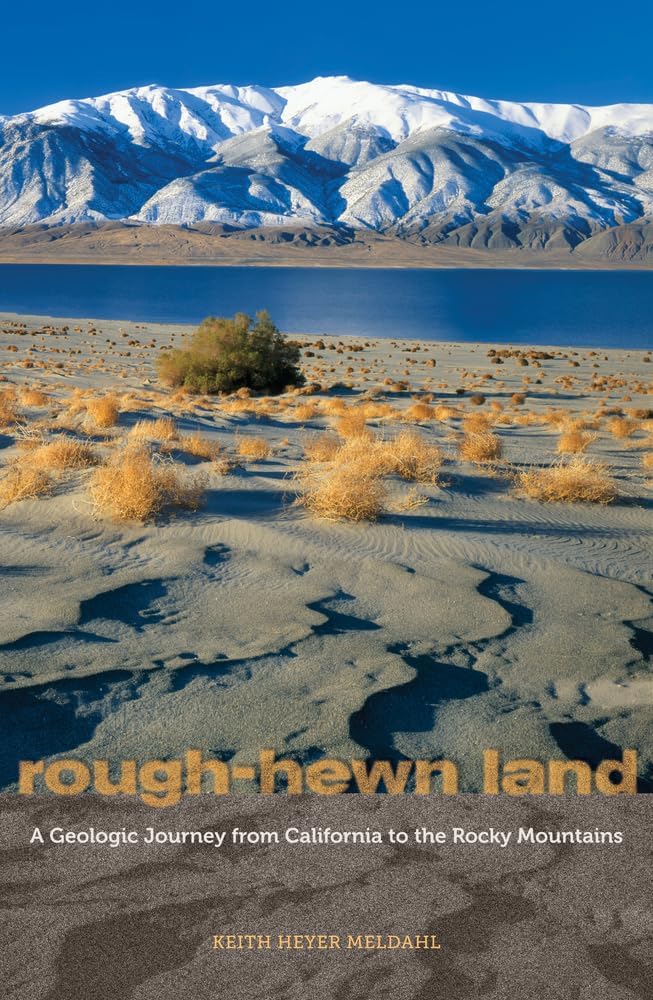
Rough-Hewn Land: A Geologic Journey from California to the Rocky Mountains
Product ID: 6493875
📊Detailed diagrams & photos
📍GPS coordinates for field trips
🗺️1000-mile geologic journey
Desertcart purchases this item on your behalf and handles shipping, customs, and support to QATAR.
🌄 Unlock the Earth’s secrets from coast to peaks — don’t just read geology, experience it!
Rough-Hewn Land offers a compelling, expert-driven exploration of the western US geology, combining a 1000-mile field journey with vivid illustrations and GPS-guided outcrop locations. It uniquely blends deep scientific insight with engaging historical narratives, making it an essential read for geology enthusiasts and professionals alike.
| Best Sellers Rank | #201,371 in Books ( See Top 100 in Books ) #112 in Historical Geography #159 in Geology (Books) #2,244 in U.S. State & Local History |
| Customer Reviews | 4.8 out of 5 stars 165 Reviews |
S**V
Brilliant trip west through the rocks!
When it comes to books written about geology for a general audience there is only one definitive classic: Annals of the Former World by John McPhee. It's hard to imagine that anything could really improve upon the classic, but I think Rough-Hewn Land has in many ways added to McPhee's geological chronicle across the western portion of I-80 and is a worthy companion piece. For a complete history of the assembling of California to the exhumation of the Rockies you can't go wrong with either of these books, but there are a few key differences: The first key difference between Rough-Hewn Land and the Annals, is that Rough-Hewn Land has been written by a professional geologist, that is intimate with the geology of the western United States. McPhee uses his unique narrative style to essentially relate a very detailed interview/tour guide of a local expert. Medahl on the other hand is the expert, so his story is more coherent and complete. He also is better at relating how plate tectonics controls the dramatic landscapes of the American west. I was worried that Medahl's prose would be somewhat dry considering that he is a professor after all, but I was pleasantly surprised that his writing is not only very readable but it is also quite enjoyable. There was even a bit of humor in his writing, that is if you find geologist “humor” to be funny (Beer cans are used at one point to illustrate a concept). And if the geology bores the reader Medahl has included some asides into the regional histories like the California gold rush and why the geology of Utah doomed the Donner Party long before they got to the infamous pass named in their honor. However, it does lack the amateur enthusiasm of the McPhee's books. Medahl like most geologist is quite passionate about his subject, but it's not the kind of enthusiasm of a first discovery. Another major difference between the Annals and Rough-Hewn Land is that Medahl has peppered pictures and block diagrams to help illustrate the more complicated bits. Geology is a very visual sort of science and without a diagram or picture it's hard to visualize what the author is talking about. The Annals completely lacks diagrams of any kind, making it more difficult to truly understand what's going on for the uninitiated. This is a big plus in favor for Rough-Hewn Land. Another huge factor in favor for Rough-Hewn Land is an appendix that list many of the outcrops complete with GPS coordinates that Medahl visited when putting this book together. So it's possible to construct a field trip along I-80 to get a first hand look at the geology. Plate tectonics also plays a much bigger part in Rough-Hewn Land. This isn't necessarily a fault of the Annals so much as it is a matter of time. Since Annals has been written our understanding of the plate tectonics and the fault systems of the American west has increased exponentially. Medahl using a modern evidence goes so far as to say that the San Andreas may not be the western most edge of the North American Plate. Instead he proposes that the actual edge of the North American Plate is further inland near the Sierra Mountain range and that there is a smaller plate called the Sierran Plate which should be considered a separate plate from the North American Plate. A very intriguing hypothesis to say the least and the evidence for Medahl's argument is compelling. In this respect Rough-Hewn Land is a welcomed update to the Annals. Lastly another key difference is the direction of the traverse across the western portion of the United States. Rough-Hewn Land starts on the west coast and finishes in the plains where McPhee chooses to go in the opposite direction. From my point of view this is the proper direction to tell a complete history of the west. It makes more sense to go from the younger events and work our ways backwards in time rather than going from the old to the new. This is not an intuitive notion for sure, but it just makes more sense when you are trying to put it altogether. Rough-Hewn Land is a proper geology book, not just an update to the Annals of the Former World. I'm now adding a book to a very short list of geology books to recommend to a newly minted enthusiast. It's as enjoyable as it is informative, easy to read and understand, full of pictures and diagrams, and GPS points to get out into the field. Brilliant!
B**X
This is a first rate didactic master piece on the geology of the Western US
Put bluntly: This is a first rate didactic master piece. Only someone with a truly deep and broad understanding of his field can write like this. It is indeed a rare occasion that a science book is so captivating that one can’t put it down! It’s a must read for anyone living west of the Rocky Mountains. It will leave you rattled when it begins to dawn on you what goes on underneath your feet, the colossal forces, almost endless time scales, and the rather unique combination of geological events that shaped the western part of the US. Pacific Oceanic floor on the western slopes of the Sierras? Eruptions that make Mt. St. Helens look puny? A mountain range jumping some 12 feet in a few seconds? Just be glad you weren’t anywhere near when it happened, in California, and some of it not so long ago. Even though it is written for folks with no geology background, the author always explains why the things happen that he describes, what the evidence is for the conclusions he draws, and even where expert opinions still differ. Why was there gold in the western Sierras, why is the Central Valley this huge flat expanse, why is there a San Andreas fault, why do Basin and Range, Owen’s Valley and the Rocky Mountains even exist – the list goes on. In addition to many photos and maps, the book contains thoughtfully composed sketches that are very insightful, and an appendix that describes where precisely one can find the places shown in photographs (longitude and latitude to put into e.g. Google Maps). I’m a retired physicist and I read a lot, but this is one of the best books I have read in the last ten years! My advice to anyone interested in CA geology is: This is the first book to read - five stars, hands down. Prof. Meldahl, my hat off to you, and I thank you for a fantastic read.
M**E
Very readable. Lots of new material even for the well read science buff
I thoroughly enjoyed this read. The only trouble with it was it ended too soon. It is quite engaging, even if you follow science news with a particular interest in geology. Some of it I had missed, some of it I knew but the other does a great job of putting it all into context, in clean readable prose, with a nice dollop of the historical and no purple prose, as some classic authors are wont to do. Answers just about all of my questions, even the one I had while reading about quakes in the basin and range causing mountains to rise (footnote makes clear: it's probably the basin falling, not the mountain rising but it's hard to be sure and most people think of it as the former). One strange coincidence: I've always wondered about some folded red, thin beds I saw near the north side of golden gate bridge. It's been over 30 years but I actually remember those beds quite clearly and the nearby military emplacement rather poorly. Imagine my delight when early on the author covers that very spot, even pointing out the chert is a lot more interesting than the old concrete (I quite agree :) From the south pier of the golden gate to why the sierra's are rising to a host of other questions, this tells the whole story. I think you'd have to be a near professional geologist to know everything in the book and even the more familiar terrain is made interesting as it is placed in context.
T**A
A thrilling read!
A thrilling read! I sipped one section at a time and delved into places present in each section. I did learn new places along his journey and their geologic importance. It took me from the West Coast (San Francisco) along I-80 through Sierra Nevada. He didn't just tell a story of geology but also history. I learned interesting history of Gold Rush and how it affected the area geologically. His intertwining of the two subjects makes the book so impressive. Across Basin and Range, he discussed a story of early expeditions searching for the easy water way (Buenaventura River) from east to Pacific Ocean but getting disappointed when learning that no river crosses Sierra Nevada. The section "where rivers die" sounds very romantic and well-apted. I didn't think there were much interesting in Basin and Range. It was him who changed my view to this area. Well done, Keith! He keeps doing his great job when it comes to the Rocky Mountain (my favorite mountain range) Here I learned a lot about Wyoming, of which what I knew earlier is just Grand Teton and Yellowstone. Cheyenne and Laramie are very geologically interesting. His narration has changed my perspective when I'm looking at US maps. This book also inspired my trip last fall (2016) to Northern Sierra (Lake Tahoe, Carson City, Reno) as well as Lassen, Mount Shasta, Crater Lake. Along with reading, I kept searching on Wikipedia, Google Maps, Google Earth, so I was so immersed reading the book. After traveling the above trip, I got back to the book and feel even more related. So much from this book has lived in me. His excellent writing style not only inspires but also teaches me geology. Reading his book makes me feel like I'm traveling not just in place but in time as well. I couldn't love geology more and will keep an eye on his new book as well as keep searching for another geology books to pacify my curiosity in the subjects. Great job, Keith! I hope I can meet you in person or attend your lecture to learn more of interesting stuff in geology! I have no hesitant to declare myself "I'm a big fan of you!" Wait for your new book!
A**R
Great geology guide, but stick to what you know.
A great guide for the geology of what is the United States. Meldahl keeps his writing simple enough for the non-geologist to understand while still being interesting enough for the trained geologist to appreciate. Any one making a trip to any parts of the western U.S. should read this book to better appreciate the magnificent geological forces that have created the landscape we see today. However, Meldahl's discussion of Native Americans in Part III, Chapter 13 is uncomfortable at best, and incredibly demeaning and racist at worst. Meldahl writes that "the Indians attacked them [ with vigor. Yet nothing would stop the railroad; it was the ultimate symbol of national unity...". He immediately goes on to cites incredibly racist military generals, etc. who were advocates for Native American genocide, implying (whether intended or not) that U.S. actions towards tribes was justifiable in the name of "national unity". This section of the chapter is written in incredibly poor taste and does absolutely nothing to contribute to the main objectives of the book.
M**L
If you have a basic interest in geology, this book, using the west as a proving ground, is perfect!
Having majored in Geology, and a veteran of the petroleum industry, it has been astonishing and exciting to see how many major geological ideas and concepts have changed over the past 50 years. Professional journals have covered this material piecemeal, but this is first book that I have found that brings many of these ideas and concepts together in a thoroughly readable narrative that a non-geologist can easily follow, enjoy and understand. I say non-geologist, but I thoroughly enjoyed it too! It is rare and gratifying to find a geologist who can discuss a subject with the clarity, interest and excitement that Dr. Meldahl brings to this book. The diagrams and photos add immensely to understanding the ideas discussed. If you are curious about geology, you will find the vehicle for exploring it with a trip from the Golden Gate to the plains of Wyoming in this book. If you have enjoyed John McPhee's books on the Geology along the 40th parallel (brought together in "Annals of the Former World"), you will find this book just as enjoyable and informative. I've recommended this and McPhee's books to many friends and family.
K**A
Fascinating book that entertains as you learn the geology of the American West
Terrific book - well written, well researched, and very entertaining. Even thought it came highly recommended to me, given the topic, I expected it to be a bit on the dry side. But it is not - it’s incredibly informative and peppered with human interest stories intermingled with the geological info that makes it a really easy way to gain a much better understanding of how the landscapes of the American West were formed.
H**P
Orogenes Zones, Or How I Learned About Western US Geology
I thoroughly enjoyed this book. The author writes in a style that is informative and easy to absorb. The author takes the reader on a journey from the California Coast to the eastern slopes of the Rocky Mountains, telling the history of the geology and also how that geology helped shape the western expansion of the the United States. The frequent illustrations are extremely helpful in getting the author's points across to readers unfamiliar with current geological theory. As someone who has travelled extensively in the western US, I have a new appreciation for the landscapes I've seen and am looking forward to revisiting some of these places with a new appreciation of how they came to be.
C**Y
A great story about some Hot Rocks
Ever since reading Meldahl's "Hard Road West,", which I consider to be one of the finest stories of western bound pioneers and the landscape they had to confront to make it to the promised lands of Oregon and California, I've been tempted by this sort-of follow up. But I was concerned. Afterall, Meldahl covers this same area in Hard Road West--would it be too much like reading a bad sequel? Or even repetitive? But after several years I finally caved in and it was worth it. Yes, the author deals with plate tectonics and the volcanic forces shaping the lands west of the Mississippi, but Rough Hewn Land looks much more closely at the American West Coast and inland to the Rockies, offering a more detailed insight into geological forces at work along with a deeper timeline. He also offers fascinating "potted histories" of the formation of the Atlantic and Pacific oceans with measurements of how much they are changing today. There is some history here as well, particularly about the 1849 Gold Rush and the famous Comstock Lode, but this is less a tale of the people walking the surface than it is what lies miles beneath them, and is enlivened by Meldahl's light hearted anecdotes about his own explorations of the region. Most importantly, like Hard Road West, this is a book of solid geological science, but easily told in a language accessible to any lay reader. If you are even remotely interested in the natural history of the USA, this book is for you.
Trustpilot
2 weeks ago
3 weeks ago